Why I Built a Photo Cleaner Without AI
Every photo app launching right now has AI baked in. Smart sorting, automatic tagging, duplicate detection, "best shot" selection. The pitch is always the same: let the algorithm handle it so you don't have to think.
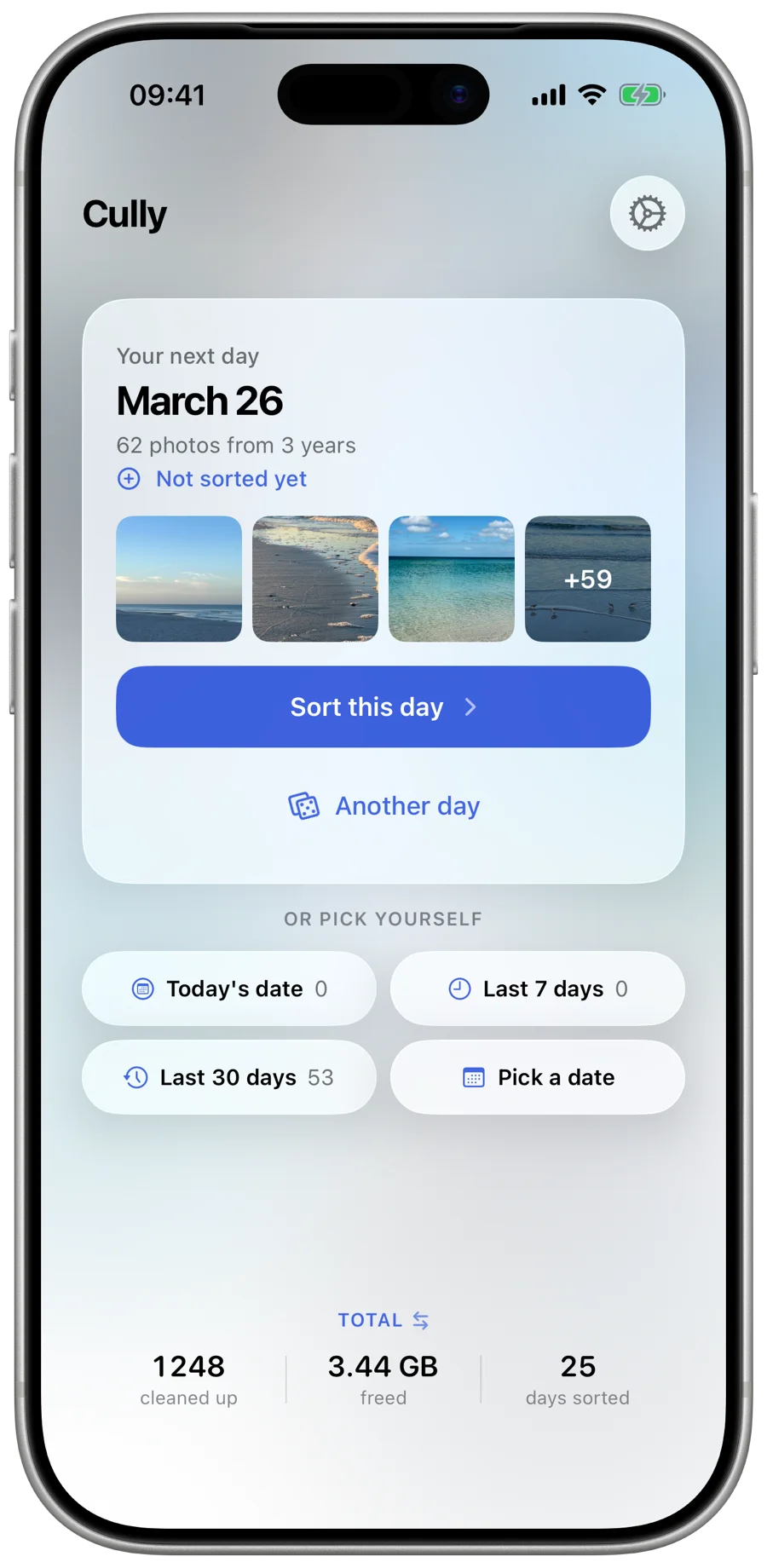
So when I started building a photo cleaner app, the obvious move was to add AI too. Scan the library, flag the bad photos, let the user confirm. Easy sell.
I didn't do that. Here's why.
The problem with AI deciding what matters
Think about the last photo you deleted. Now think about why you kept the one next to it. Odds are, the reason had nothing to do with image quality.
A blurry photo of a birthday cake might be the only photo from that party. A dark, grainy shot from a concert might be the night you met someone important. A screenshot of a text conversation might carry more emotional weight than the sharpest landscape in your library.
AI photo organizers evaluate images the way a camera reviewer would: sharpness, exposure, composition, duplicates. They're remarkably good at identifying a technically bad photo. But technically bad and personally worthless are completely different things.
When an algorithm flags a blurry photo for deletion, it's making a judgment about your life with none of the context. It doesn't know that the blurry dog in that photo died last year. It doesn't know that the overexposed selfie was taken the day you got the job. It just sees pixels.
Context that algorithms can't see
Your photo library isn't an image database. It's a timeline of your life, and the meaning of each photo lives entirely in your head. Consider what an AI photo cleaner would do with these:
- The last photo you ever took of a pet or a grandparent . Probably not the sharpest one in the bunch
- A screenshot of a message that changed your plans, your mood, or your relationship
- A "bad" photo that makes you laugh every time because of what happened right after
- Three nearly identical photos of your kid . But you know exactly which smile is the real one
- A photo of a street sign, a receipt, a whiteboard . Useless to anyone except you, and only for a specific reason
None of these have visual qualities that signal importance. An AI trained on millions of photos would reasonably suggest deleting most of them. And that's exactly the problem. Reasonable isn't the same as right.
Photo libraries aren't about image quality
There's a deeper assumption behind AI photo cleanup that I think is just wrong: the idea that a cleaner library means fewer, better-looking photos.
That's true for a photographer's portfolio. It's not true for your camera roll. Your camera roll is a journal. Some entries are beautiful, some are mundane, and some only matter to you. The goal of cleaning it isn't to curate a gallery. It's to remove the stuff that genuinely doesn't matter anymore : the accidental pocket shots, the expired screenshots, the fifteenth attempt at a photo where you already kept the good one.
That distinction, between "not a great photo" and "I don't need this anymore", is something only you can make. It requires memory, not machine learning.
What Cully does instead
Instead of trying to make decisions for you, Cully makes it fast and easy for you to make them yourself.
The approach is simple: the app picks a random date and shows you every photo from that day, across all years. Not your entire library. Just one day. Maybe it's 8 photos. Maybe it's 25. Either way, it's a manageable number you can get through in a few minutes.
You see the photos in a clean grid. Pinch to zoom on anything that needs a closer look. Swipe to mark what you don't need. Done. Five minutes, and you've cleaned one more day of your library.
There's no AI analyzing your photos. Nothing leaves your phone. No cloud processing, no "smart" suggestions, no algorithm second-guessing your choices. Just your photos, your memories, your call.
The right role for technology
I'm not against AI in general. It's great at plenty of things. But I think there's an important difference between technology that makes a process faster and technology that takes over the process entirely.
When it comes to your personal photos, the decision about what to keep is the whole point. It's the moment where you reconnect with a memory and decide if it still matters. Skip that moment, and you've saved time but lost something valuable.
The role of the app should be to remove the friction around that decision. Make the library less overwhelming. Surface photos you forgot about. Give you a workflow that fits into a coffee break instead of demanding a whole afternoon.
That's what I built Cully to do. Not to think for you, but to make thinking about it quick and even a little enjoyable. Because scrolling through photos from a random day three years ago? That part is actually fun.
Try Cully
Clean up your photo library. One day at a time. Free to try, one-time unlock, no subscription.
Download on the App Store